
Criminal Court Records in Love County
A criminal court record is the case file an Oklahoma District Court opens once a charge is filed. In Love County the court clerk keeps that file. The Love County Court Clerk, Wendy Holland, records and keeps permanent records of District Court proceedings, including the criminal division. The file holds far more than a booking sheet. It carries the charging document, the counts, each plea, the hearings, the disposition, and the sentence. Bond, court costs, and any warrant or payment entry sit in the same record. One case can run for months, and every step is added to the docket as it happens.
Love County District Court is the trial court of general jurisdiction for these cases. Felony matters use the CF prefix. Misdemeanors use CM. The District Attorney files state charges here, while the Marietta Municipal Court handles city ordinance and adopted state-law violations on its own docket. Serious federal crimes do not sit in the county file at all. For a wider look at every case type the clerk keeps, the broader Love County court records index covers civil, family, and probate files alongside criminal ones.
How to Search Love County Criminal Court Records
The Court Clerk links the public to ODCR for case lookups. ODCR lets you search by court, party name, case type, and case number. Select Love as the court to pull Love County District Court criminal files. The Oklahoma State Courts Network gives a second path with daily dockets and District Court reports, though some of its screens show a human-verification step.
- Open the ODCR court-record search and set the court to Love.
- Enter the defendant name as Last, First, or type a full case number.
- Choose a case type such as Criminal Felony or Criminal Misdemeanor to narrow results.
- Open the case to read the docket, the charges, and the disposition.
- Ask the Court Clerk for a certified copy when you need one for court or an agency.
You can also reach state docket reports through the Oklahoma State Courts Network. For balances on disposed cases, the court runs a separate e-payment search. Paying online does not recall a warrant on its own, so call the clerk after payment if one has issued.
OSBI vs Love County Criminal Records
A statewide criminal history is not the same as a Love County case file. The Oklahoma State Bureau of Investigation keeps the statewide record. It pulls together arrests and charges reported from across the state. The court file shows one case in full detail. The OSBI record gives a person's broader history in summary form.
You can order a statewide record through the OSBI criminal-history request portal, which handles public name-based and fingerprint requests.
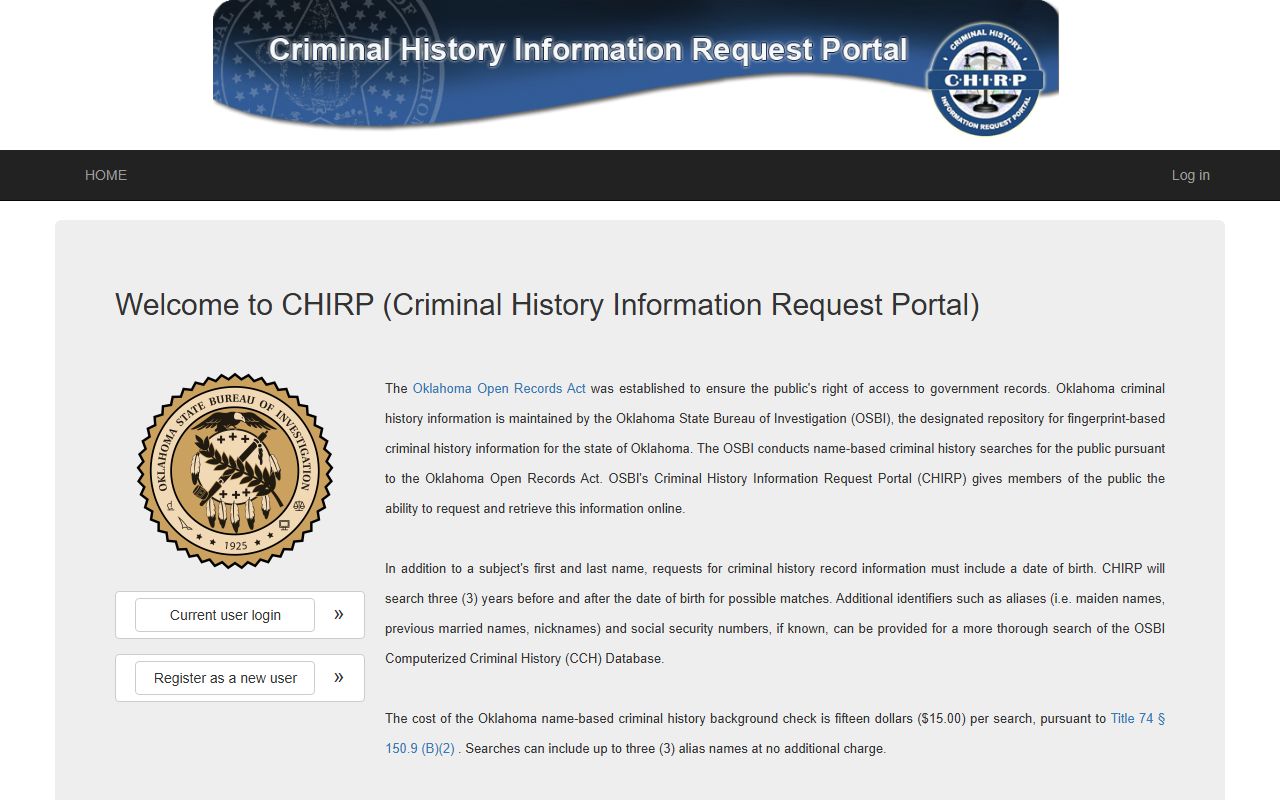
This channel reports criminal-history information, not the day-by-day docket. Use it for a background-style summary, then pull the matching Love County District Court case file for the charges, pleas, and sentence on a specific case.
Note: OSBI criminal history and the county court file are separate records, so a full picture often means checking both the statewide portal and the District Court docket.
Stages of a Love County Criminal Case
A criminal case moves through set stages, and each one leaves a mark on the record. The charge starts it. Arraignment, hearings, and a plea or trial follow. The case ends with a disposition and, where there is a conviction, a sentence. Reading the docket in order shows where a case stands today.
Case flow: Charges Filed › Arraignment › Pretrial / Preliminary Hearing › Plea or Trial › Disposition › Sentencing
| Stage | What Happens |
|---|---|
| Arraignment | The defendant hears the charges and rights and may enter a first plea. |
| Preliminary Hearing | A felony case is tested for probable cause before it moves ahead. |
| Pretrial / Motions | Lawyers file motions, trade evidence, and argue what a jury can hear. |
| Plea or Trial | The defendant pleads, or a judge or jury decides guilt at trial. |
| Sentencing | After a conviction the judge sets jail, probation, fines, or costs. |
Who Charges and Defends a Criminal Case
State charges in Love County come from the District Attorney for the 20th Judicial District. Melissa Handke holds that office. The District 20 District Attorney serves five counties: Carter, Johnston, Love, Marshall, and Murray. The DA reviews the arrest, decides the formal counts, and files the case in District Court. For a closer look at how those counts are filed and how they change, the Love County arrest records and court charges page tracks the charge side.
A defendant who cannot afford a lawyer may ask the court for appointed counsel. The Oklahoma Indigent Defense System provides that representation for eligible people, and the court decides eligibility. The DA prosecutes, the defense answers, and the judge rules. Every filing from each side lands in the same case file, which is why the docket reads as a running history of the case.
What a Love County Criminal Court Record Shows
The criminal file is built from many fields, and Oklahoma District Court records follow a steady layout. Case number and prefix sit at the top. Party names, the charge list, hearing dates, the judge, and the disposition follow. Financial entries track costs, fines, and payments. The table below breaks down the core fields a reader will meet.
| Field | What It Shows |
|---|---|
| Case Number | The court ID and prefix, such as CF for felony or CM for misdemeanor. |
| Defendant | The person charged in the case. |
| Charges | Each count filed, tied to an Oklahoma statute. |
| Plea | The defendant's formal answer, such as guilty, not guilty, or no contest. |
| Disposition | The result of each count, from dismissal to conviction. |
| Sentence | The punishment ordered, including jail, probation, fines, or costs. |
Case prefixes are worth learning. CF marks a felony and CM a misdemeanor. TR covers traffic, WL covers wildlife, and PO marks a protective order. The ODCR case-number control lists many more, so treat these as common examples rather than the full set.
Charges vs. Convictions
A charge is an accusation. A conviction is a finding of guilt. The two are easy to confuse in a record, and the difference matters. A file can show charges that were dropped, dismissed, or that ended in an acquittal. None of those is a conviction. Only a guilty finding or an accepted guilty or no-contest plea creates one.
| Charge | Conviction | |
|---|---|---|
| Stage | Accusation | Verdict or plea |
| Burden of Proof | Probable cause | Beyond a reasonable doubt |
| Public Record | Yes | Yes |
Note: a charge on the docket does not prove guilt, so always read the disposition line before drawing a conclusion about a case.
Reading Love County Criminal Dispositions
The disposition line tells you how each count ended. Common results include guilty, not guilty, dismissed, and nolo contendere, a no-contest plea treated like a conviction for many purposes. A deferred sentence holds judgment back while the person meets conditions. The sentence line then sets the punishment, whether that is jail time, probation, fines, restitution, or court costs.
For people who draw a prison term, custody shifts to the state. The Oklahoma Department of Corrections holds sentenced offenders, not the county jail. You can confirm a custody status through the Oklahoma DOC offender lookup.
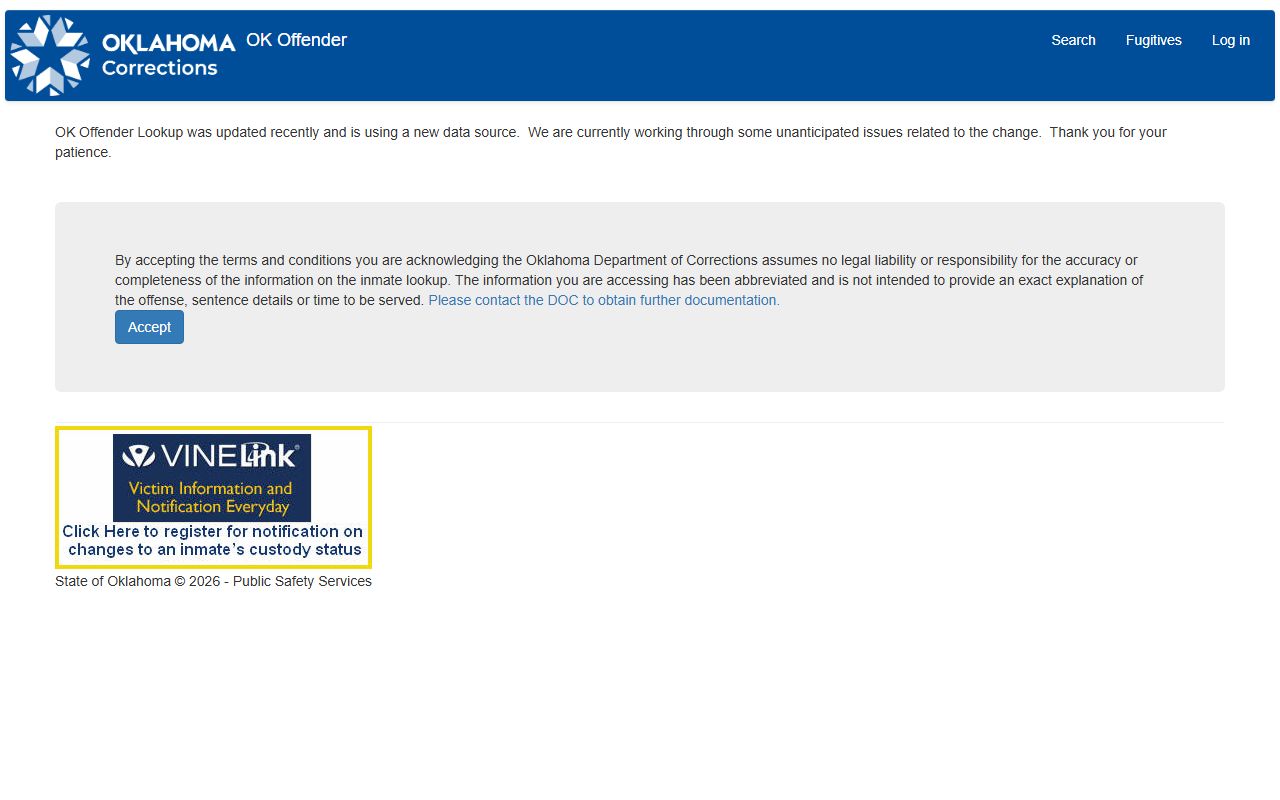
The DOC tool gives an abbreviated summary and warns that it is not the exact sentence text. For the precise terms, read the sentence line in the District Court file itself. A short-term defendant still in the county jail will instead appear on the local roster.
Sealed vs. Expunged Records
Not every criminal record stays open forever. Oklahoma law lets eligible people seal or expunge certain records. Sealing hides a record from ordinary public view. Expungement goes further and treats the record as though it never existed for most purposes. Both need a court process, and neither happens by asking a website to drop a result.
| Sealed | Expunged | |
|---|---|---|
| Visibility | Hidden from public view | Treated as if it never existed |
| Law Enforcement | Limited access | Very limited access |
| Eligibility | Set by court order under state law | Set under 22 O.S. Sections 18 and 19 |
The expungement path runs through the District Court. A Love County petitioner identifies the statutory basis under 22 O.S. Sections 18 and 19, files a petition with the Court Clerk, pays the fee or seeks a waiver, and serves the prosecutor and the agencies that hold the record. If a judge grants relief, the order goes to the Court Clerk, OSBI, the sheriff, and any other record holder so each can update its files. A deferred sentence, an acquittal, a dismissal, or an old eligible conviction can each call for different relief, so eligibility is never automatic.
Public Access to Love County Criminal Records
Most criminal court records in Oklahoma are open. The Open Records Act treats public-body records as open unless a statute makes a category confidential. Court files, dockets, and dispositions generally fall on the open side. The clerk can still hold back sealed material, juvenile details, and certain personal identifiers even when a case is public.
Key Statutes:
Oklahoma Open Records Act, 51 O.S. § 24A.1 et seq. - public records are open unless a law makes them confidential.
Oklahoma Statutes 51 O.S. § 24A.5 - records are open for inspection and copying during regular business hours, subject to set exceptions.
Federal Criminal Cases for Love County
Some crimes are not state cases at all. Federal charges route to the U.S. District Court for the Eastern District of Oklahoma, which sits in Muskogee and counts Love County among its 26 counties. These files are kept by the federal court, not the Love County Court Clerk. Federal prosecutors handle them.
The prosecuting office is the U.S. Attorney for the Eastern District of Oklahoma, which describes the district as entirely Indian country.
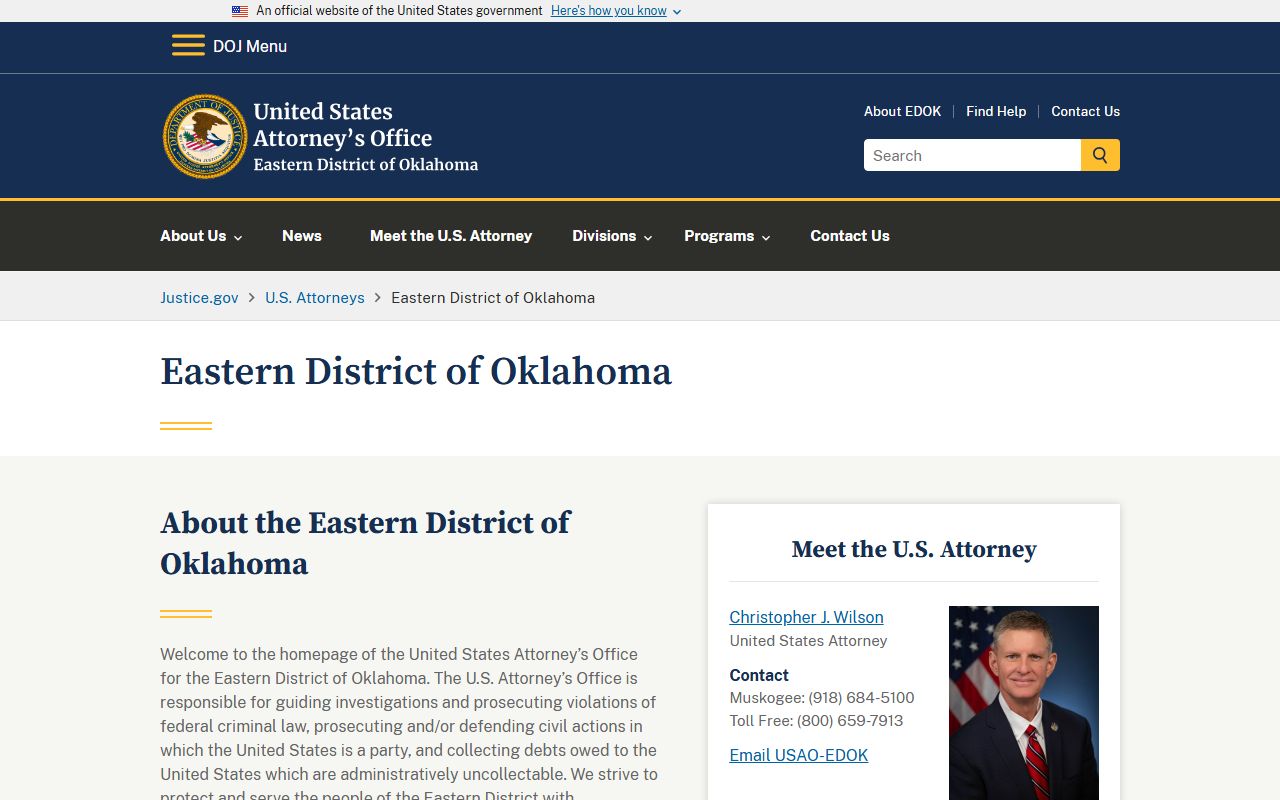
That Indian country status shapes which criminal cases land in federal court for eastern Oklahoma. The district lines themselves are set by statute, not by the local court.
The boundary comes from 28 U.S.C. 116, which names Love County in the Eastern District of Oklahoma.
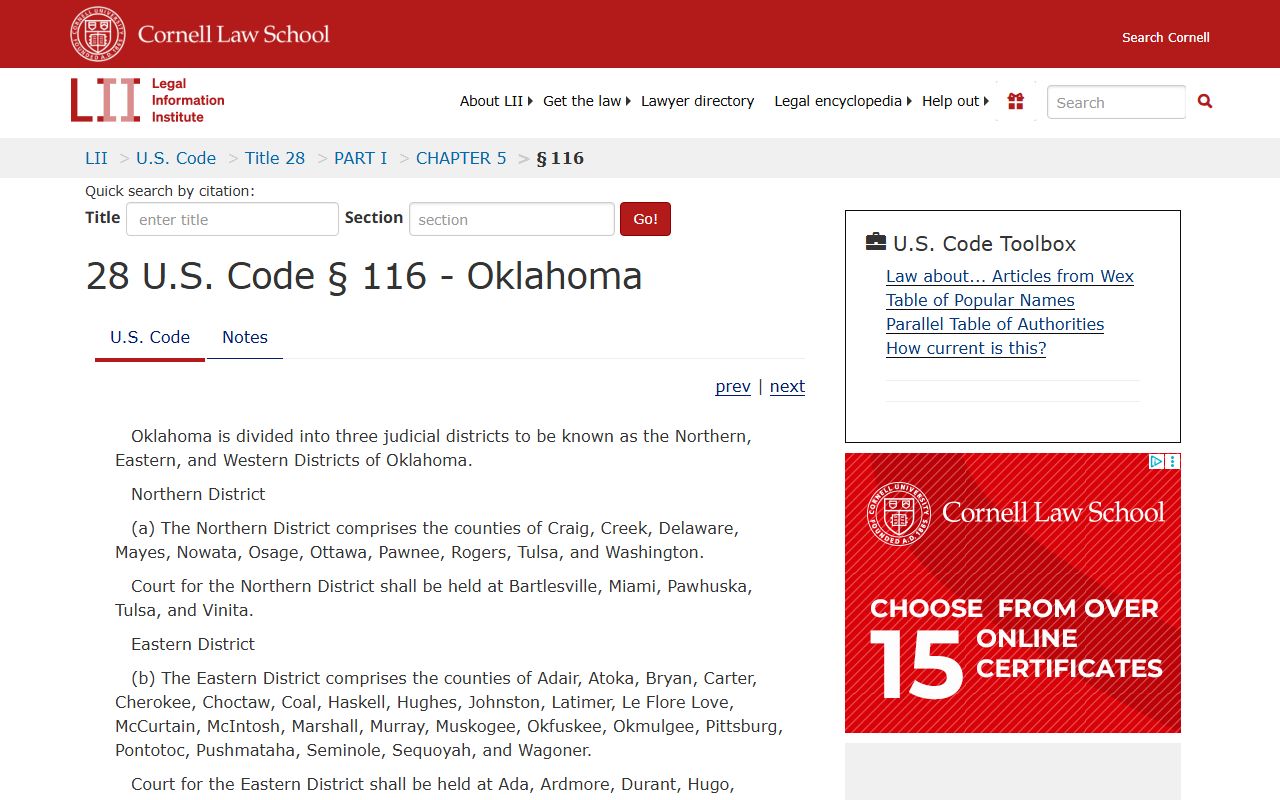
Federal cases run on the PACER system rather than ODCR. For a state case, the Eastern District court site is the wrong door, so keep state charges in the District Court file and federal charges in the federal one.
Note: a federal case and a Love County District Court case are tracked in different systems, so check the right court for the charge you are following.
Background Check Considerations
People read criminal court records for many reasons. A casual name search is not the same as a formal background check. Formal checks for jobs, housing, or credit fall under the federal Fair Credit Reporting Act and must run through a regulated agency. A free court lookup is a public-record review, not an FCRA-compliant report.
Important: This site is not a consumer reporting agency under the FCRA, and its records may not be used for employment, housing, credit, or other FCRA-covered decisions.
Restricted Criminal Court Records in Love County
Some criminal records stay out of public view. Juvenile cases are handled by the court clerk but are commonly confidential. Sealed and expunged cases may not appear in the public portal at all. Active investigations, sealed search warrants, and sealed indictments can be withheld until they are executed or unsealed. Adoption and mental-health matters carry their own confidentiality rules.
Personal identifiers add another layer. Social Security numbers, financial account numbers, and minor identifying details may be redacted even when the case itself is open. When a record is restricted or missing online, the Court Clerk is the office to ask whether it is legally open and how to request it.