
Love County Arrest Records and Court Charges
A Love County arrest record is the record of the arrest itself. It shows who made the arrest, when the person was booked, and the offense listed at booking. The sheriff keeps this side. Booking detail and the jail roster sit with the Love County inmate records, not the court clerk. An arrest is only the start. It does not decide guilt, and it does not by itself create a court case.
The court charge record begins when the prosecutor acts. After an arrest the District Attorney reviews the facts and decides the formal counts. Those charges after arrest are filed with the court clerk, where they open a District Court case. From that point the charges are tracked through the case. The full case file, the plea, and the outcome live in the Love County criminal court records. The arrest record and the charge record answer different questions, so a complete picture often needs both.
How to Find Love County Arrest Records and Charges
The charges filed after an arrest show up in the court case index. The Court Clerk links the public to ODCR, where you can search by court, party name, and case type. Select Love to pull Love County District Court cases. Arrest and booking detail itself lives with the jail roster, not the court file, so the two searches often run in parallel.
- Open the ODCR court-record search and set the court to Love.
- Search by the defendant's name as Last, First, or by a full case number.
- Open the case and read the full charge list.
- Check each charge for its code, level, and current status.
For a statewide criminal history rather than a single case, the OSBI request portal is a separate channel. For the arrest and booking side, the sheriff's office is the custodian of its own reports and arrest history.
How Charges Get Filed After an Arrest: Complaint, Information, and Indictment
The charge record begins with a charging document. After booking, the case does not move until the prosecutor files one. In Oklahoma the District Attorney for the 20th Judicial District, Melissa Handke, files state charges for Love County and four neighboring counties. The District 20 District Attorney reviews each arrest and decides the counts. Three document types are common, and the table sorts them out.
| Complaint | Information | Indictment | |
|---|---|---|---|
| Filed By | Officer / Prosecutor | Prosecutor | Grand Jury |
| Common For | Misdemeanors | Many felonies | Serious felonies |
| Starts | The case | The case | The case |
A misdemeanor often starts with a complaint. Many felonies move forward on an information after a preliminary hearing tests probable cause. A grand jury returns an indictment for some serious felonies. Each one opens the case and sets the counts the defendant must answer.
The charge label at booking and the filed count are not always the same thing. A jail record may list an offense in plain terms at the moment of arrest. The prosecutor can then file a different count, add counts, or decline to file at all. Because of this gap, a full charge record often means cross-checking the jail roster, the District Court case in ODCR, and the statewide criminal history. The arrest label is a starting point, while the filed count is the charge the court will actually weigh.
Love County Charge Status Explained
Charges rarely stay frozen. As a case moves, a count can be amended, reduced, added, dropped, or dismissed. The status line in the record tracks each change. Reading it tells you whether a charge is still live, was lowered, or went away. The table defines the terms that appear most often.
| Status | What It Means |
|---|---|
| Pending | The charge is filed and the case is still open. |
| Amended / Reduced | The charge was changed, often to a lesser offense. |
| Dismissed | The court dropped the charge, with or without the option to refile. |
| Nolle Prosequi | The prosecutor chose not to pursue the charge. |
Note: a dropped or dismissed charge can still appear in the record after a case ends, which is one reason people later pursue expungement.
Love County Charges vs. Convictions
Being charged is not the same as being convicted. A charge is what the prosecutor filed. A conviction is the finding that follows a plea or a trial. A person can be charged and never convicted. The record shows both, so the disposition line is what settles the question.
| Charge | Conviction | |
|---|---|---|
| Stage | Accusation | Verdict or plea |
| Burden of Proof | Probable cause | Beyond a reasonable doubt |
| Public Record | Yes | Yes |
Sealed vs. Expunged Love County Records
Some arrest and charge records can be sealed or expunged. Sealing hides a record from ordinary public view. Expungement goes further and treats it as though it never existed for most purposes. Oklahoma lets eligible people petition the District Court for this relief. Neither is automatic, and both follow a court process.
| Sealed | Expunged | |
|---|---|---|
| Visibility | Hidden from public view | Treated as if it never existed |
| Law Enforcement | Limited access | Very limited access |
| Eligibility | Set by court order under state law | Set under 22 O.S. Sections 18 and 19 |
Eligibility runs under 22 O.S. Sections 18 and 19. A petitioner files with the Court Clerk, serves the prosecutor and the agencies that hold the record, and obtains an order before any file is updated. A dismissal, an acquittal, a deferred sentence, or an eligible old conviction can each support a different path, so the basis matters.
Requesting Love County Arrest Records from the Sheriff
The arrest side of the record sits with the sheriff. The Love County Sheriff's Office runs a Records Division that takes open-record requests for offense and incident reports and arrest history. A published fee schedule keeps copy costs simple. Copies and reports run $1 for the first page and $0.50 for each added page, with the same rate for fax, email, and scan delivery.
The starting point is the Sheriff records request page, which describes the division and links the request form.
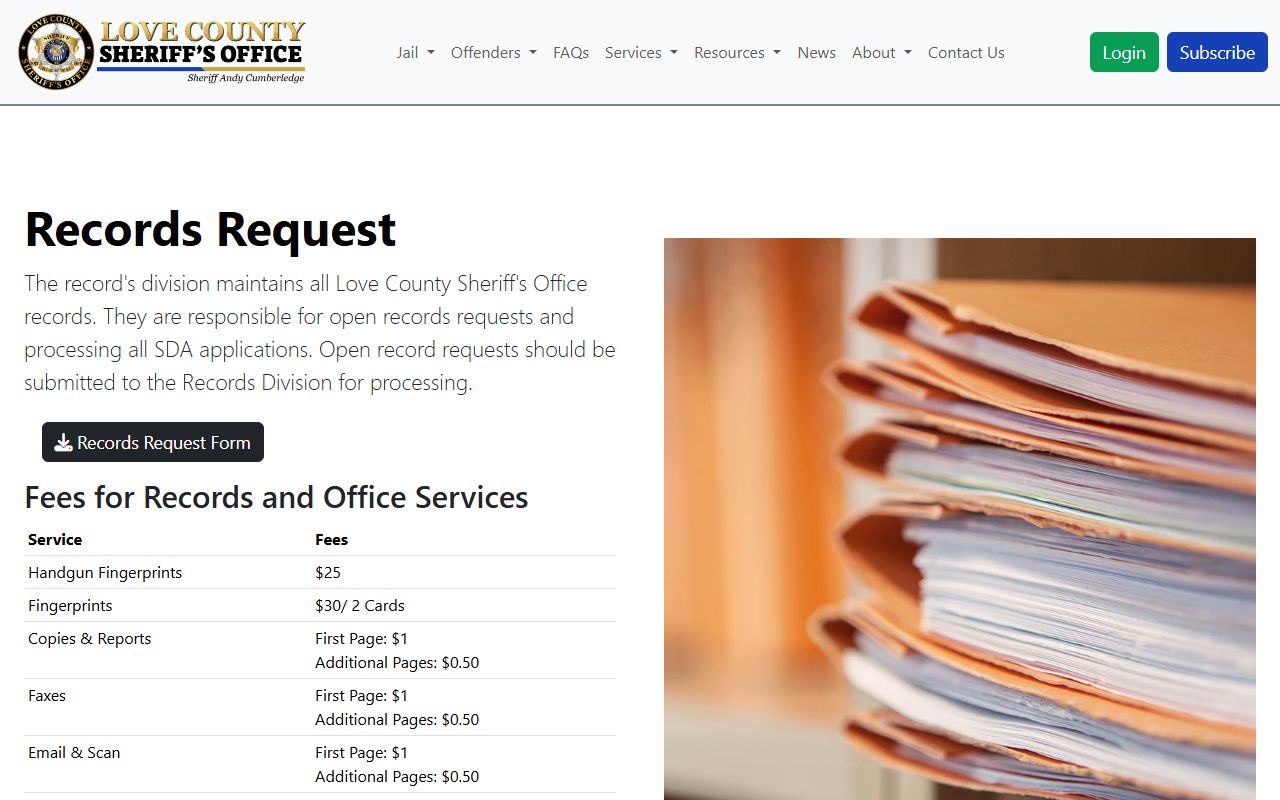
The page notes that processing can take up to a week, and that a record tied to an open investigation is not released until the case closes.
The request itself uses a fillable open records request form, which asks for the requester's details and the record type.
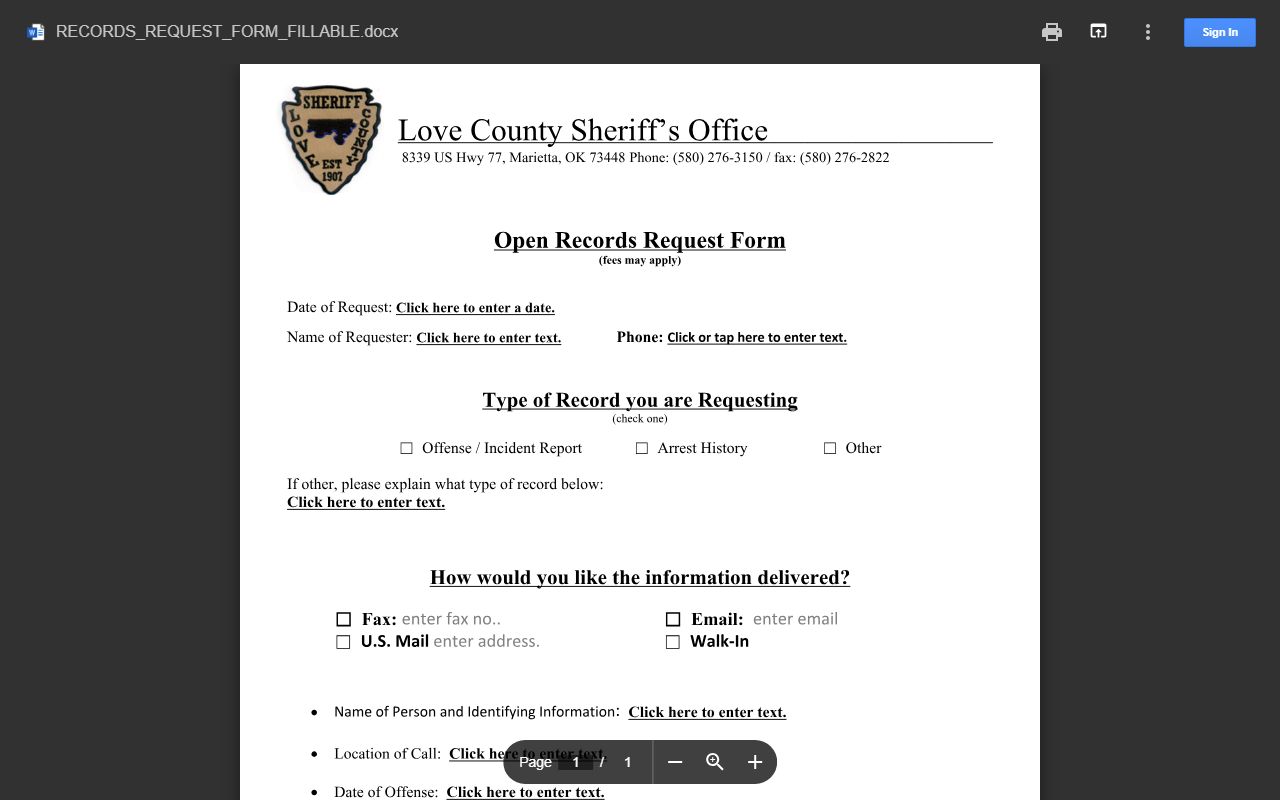
The form lets you check Offense or Incident Report, Arrest History, or Other, and pick fax, email, U.S. mail, or walk-in delivery. A case number, a date of offense, and the person's name help the division find the right file.
Separately, the office takes anonymous reports through an online tip form, which is for sharing information, not requesting records.
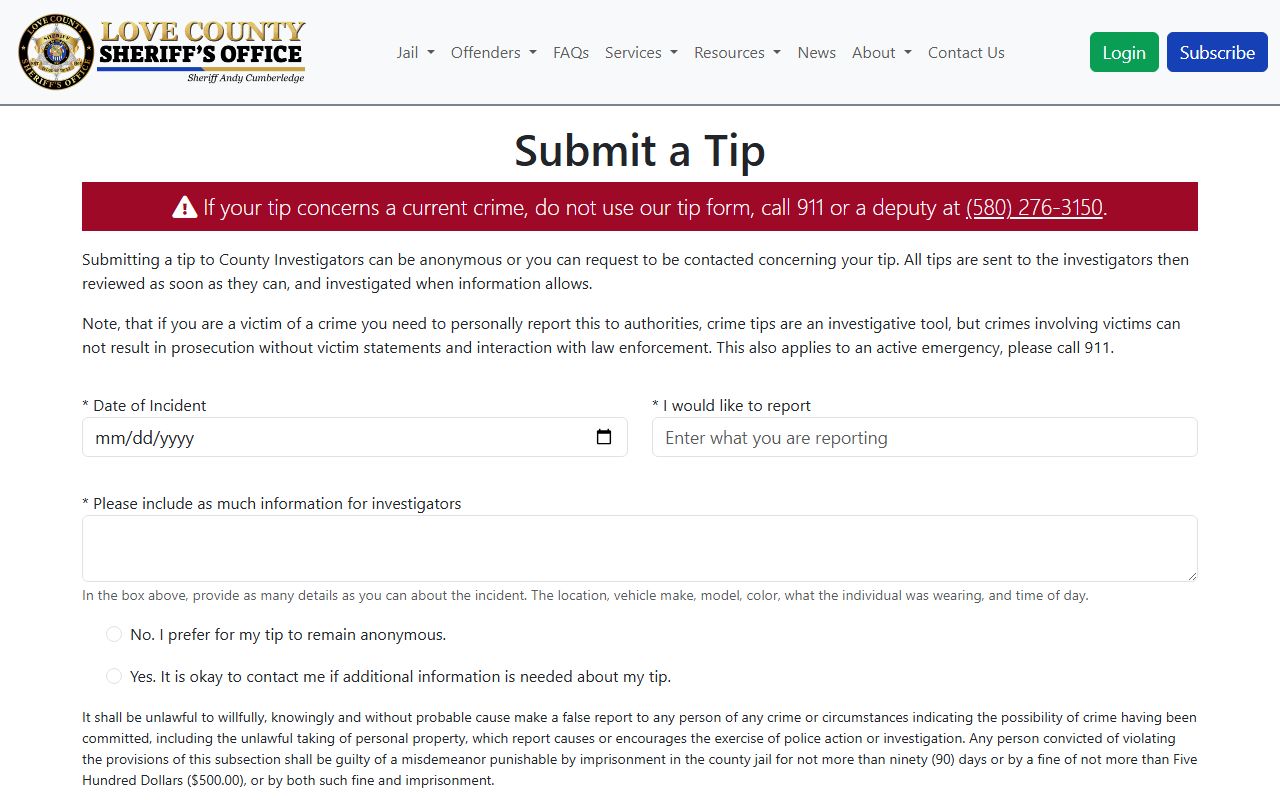
The tip form is not a records channel, and it warns that a false report without probable cause can be a misdemeanor. For records, use the request form. For a crime in progress, the office says to call 911 or a deputy.
Note: the sheriff's records request covers the arrest side, while the filed charges and case outcome stay in the District Court file with the court clerk.
Love County Charge Codes and Levels
Each charge is coded to a statute. The code points to the law the person is accused of breaking, and the level sets how serious it is. Oklahoma sorts offenses into felonies, misdemeanors, and lesser violations. A felony carries the heaviest penalties. A misdemeanor is less serious but still criminal. One arrest can produce several separate charges, each with its own code and level.
Case prefixes echo these levels in the court index. CF marks a felony case and CM a misdemeanor. TR covers traffic and WL covers wildlife. Reading the prefix and the statute code together tells you what class of offense the record describes, and a single case number can hold more than one count.
Statewide Charge and Criminal History Lookups
A single Love County case is one slice of a person's history. For a statewide view, the Oklahoma State Bureau of Investigation keeps the criminal-history record. It gathers charges and arrests reported from agencies across the state. This is a separate channel from the county court file and the jail roster.
Public requests go through the OSBI criminal-history request portal, which handles name-based and fingerprint-based searches. The OSBI record reports criminal-history information in summary form, not the full docket of any one case, so pair it with the District Court file when you need the detail of a specific charge.
Note: OSBI reports a statewide history, while the county portal shows the single Love County case, so the two searches answer different questions.
Love County Sex Offender Records
One category of charge record stays public by design. People convicted of qualifying sex offenses appear on Oklahoma's registry, and the sheriff publishes registry information for the county. The registry rests on a state statute, not on a single case file. It reflects a conviction, so it is a different record from a pending charge or an arrest entry.
The Love County Sheriff's sex-offender registry disclaimer cites the Oklahoma Sex Offenders Registration Act, 57 O.S. Sections 581 through 590.2, as the basis for that public information.
The disclaimer reminds readers that registry data is provided for public safety and must not be used to harass or threaten any person. For the charge or conviction behind a listing, the matching District Court case still holds the counts, plea, and sentence.
Background Check Considerations
Casual record lookups and formal background checks are not the same. A formal check for a job, an apartment, or credit falls under the federal Fair Credit Reporting Act. Those checks must run through a regulated agency. A free arrest or charge lookup is a public-record review, not an FCRA-compliant report.
Important: This site is not a consumer reporting agency under the FCRA, and its records may not be used for employment, housing, credit, or other FCRA-covered decisions.
Restricted Charge Records in Love County
Not every arrest or charge record is open. Juvenile charges are commonly confidential. Sealed and expunged charges may not appear in the public portal. Some dismissed charges are withheld once a record is cleared. Active investigations stay closed until a case is filed or completed.
Personal identifiers can be redacted even on an open case. Social Security numbers, account numbers, and minor identifying details are often removed. When a record is missing or restricted online, the right step is to ask the custodian, whether that is the Court Clerk for the case file or the Sheriff's Records Division for the arrest side.